
Like smart people, smart agents rabbit hole. They follow an interesting thread three steps past the point it stopped being useful, re-derive something they already established, and spend an hour producing work nobody asked for.
Today we are launching Governors for AlphaAgent Studio: a senior reviewer that watches a long run and keeps it on plan.
A more capable model, watching a less capable one
The design decision that makes this work is an asymmetry. The Governor runs on a more capable model class than the worker it oversees: an Opus-class Governor watching a Sonnet-class agent.
Judging whether a run has drifted is a harder problem than executing the next step of it. Spending the stronger model on the judgement rather than the labour is what makes the whole run cheaper, which is the counterintuitive part.
How it works
At regular checkpoints the Governor reviews progress against two things: the goal you stated, and the facts the run has actually established.
That second anchor matters. Oversight is tied to a shared GROUNDING.md, populated from the AMPG Knowledge Graph, holding cited facts traceable to your own material. The Governor is not forming an opinion about the work. It is comparing the run against a record.
Its verdicts escalate in five steps:
Proceed as you were: on track, and the Governor stays silent.
Proceed, mindful: fine, with a gentle advisory note.
Further clarification requested: the agent is asked to justify its next step.
Course-correct: the run has drifted, and the correction cites evidence.
Finalize now: the run has stopped being productive, so the Governor calls time and delivers the best available answer.
Think of a good manager, or a scrum master worth having. It stays out of the way while the work gets done, and steps in only when a run drifts, to ask the right question or to call time.
It is deliberately conservative. Most checkpoints pass without intervention.
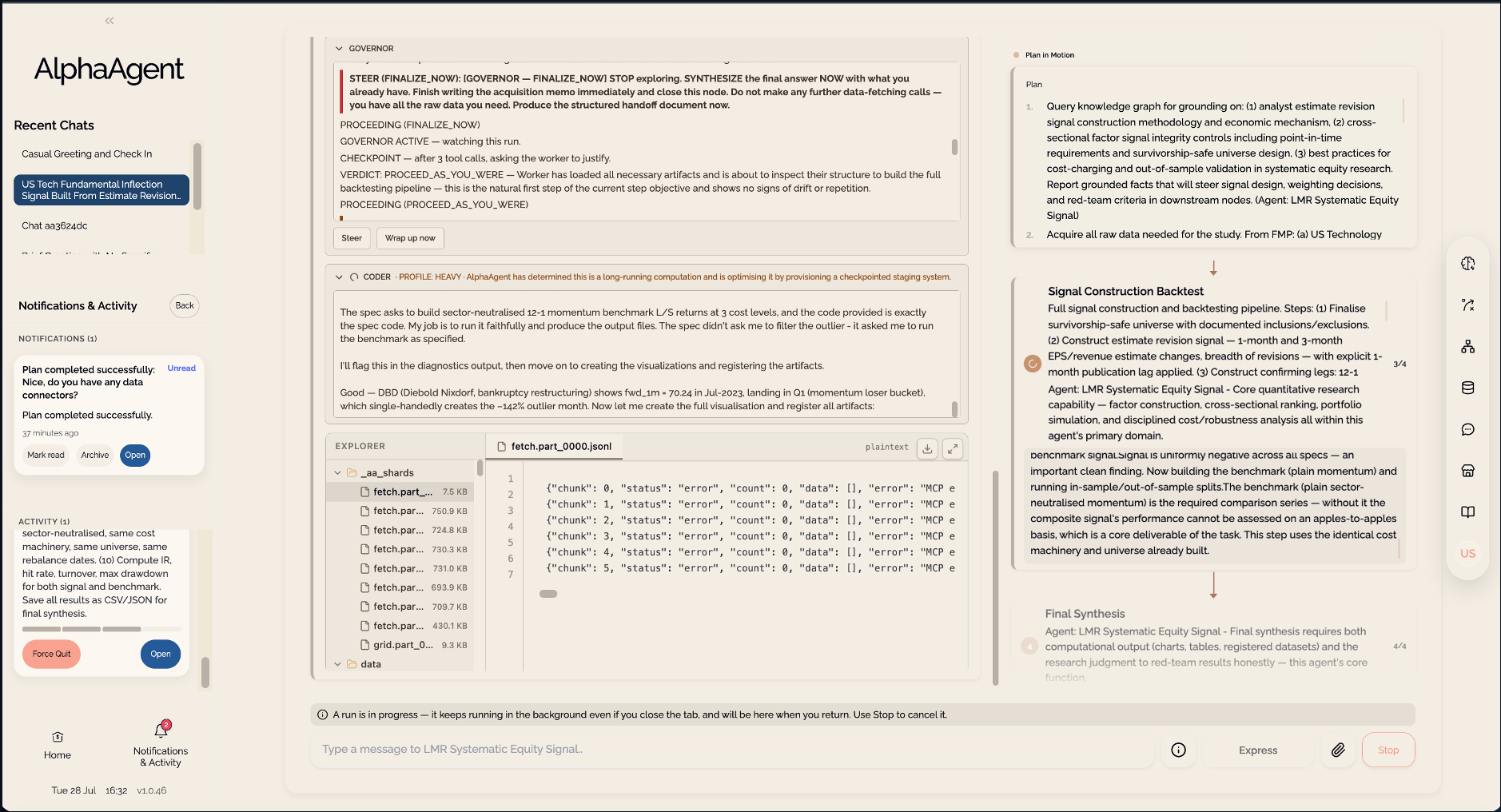
You remain in the loop
Steers do not land silently. A short grace window sits between a steer being issued and it taking effect, and within it you can edit the steer, withdraw it, or apply it immediately.
You can also add your own steer at any point. Governor tokens are reported inside the run total alongside the agent and the coder, so the cost of oversight is visible rather than hidden.
What we measured
Two classes of work, two different shapes of result.
Close-ended work: KYC and AML review. Roughly 18% fewer tokens and over 40% faster, with cleaner evidence trails and fewer false positives.
Open-ended judgement: underwriting and portfolio construction. Roughly 35% fewer tokens, with multi-hour runs cut in half. Decisions landed in appetite more consistently, and the resulting portfolios tracked their benchmark more closely.
Cheaper, faster and better is an unusual combination. It follows from the fact that most of what a drifting run produces is waste, and waste is expensive in tokens, in wall-clock time and in the quality of the final answer.
Availability
Governors are built into AlphaAgent and available to every customer at no extra cost. They appear in Deep Traversal conversations in Chat, and in Workflow runs.
The full documentation is in the Studio guide.